

bookey
app storegoogle play
qr-code

Scan to Download

Home | Last Updated on2026/02/05

Dialectic of Enlightenment Free Audiobook Download

Theodor W. Adorno

Exploring the Paradox of Enlightenment and Modern Barbarism

4.117232ratings(GoodReaders reference)

Information

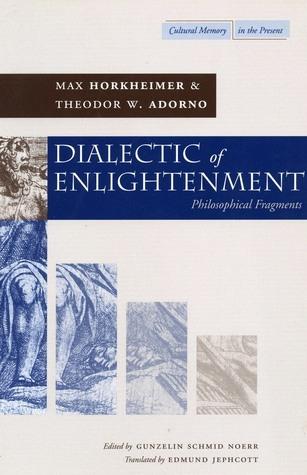
Dialectic of Enlightenment audiobook cover

Author: Theodor W. Adorno

Narrator: Brian

Format: MP3

ISBN: 9780804736336

Language: English

Publish Date: 12/22/1969

Audiobook length: 31min

Dialectic of Enlightenment Audiobook by Chapters

The audio file is large, please allow a moment for loading

Chapter 1: The Concept* of Enlightenment
playpause
download
00:00644:06
ad
bookey

Download Bookey App to Enjoy Free 5000+ Audiobook

qr-code

Scan to Download

Chapter 2: Excursus I: Odysseus or Myth and Enlightenment
playpause
download
00:0073:08
Chapter 3: Excursus II: Juliette or Enlightenment and Morality
playpause
download
00:0082:18
Chapter 4: The Culture Industry: Enlightenment as Mass Deception
playpause
download
00:0086:34
Chapter 5: Elements of Anti-Semitism: Limits of Enlightenment
playpause
download
00:0094:53
Chapter 6: Editor's afterword
playpause
download
00:00287:57
Chapter 7: The Disappearance of Class History in “Dialectic of Enlightenment”
playpause
download
00:0011:35

Who should listen Dialectic of Enlightenment

The summary audiobook of "Dialectic of Enlightenment" by Theodor W. Adorno is ideal for students, academics, and anyone interested in critical theory, philosophy, and social criticism. It caters to listeners seeking to understand the complex interplay between reason, culture, and enlightenment and how these elements shape modern society. Additionally, those intrigued by the critique of capitalism, mass media, and the consequences of industrialization will find the synopsis particularly enlightening, offering accessible insights into Adorno's and Max Horkheimer's challenging yet impactful ideas.

3 quotes from Dialectic of Enlightenment

  • "Enlightenment is totalitarian; it argues that the instrument of liberation, once it emerges from oppression, it drags with it nurturing oppression."
  • "The collapse of the Enlightenment into myth is both a fact and a dilemma; it suggests that reason alone, without reflection, leads back to myth."
  • "The culture industry conditions the individual to engage with society in a way that is superficial and detached, leading to a loss of critical consciousness."

Author : Theodor W. Adorno

Max Horkheimer (1895–1973) was a prominent figure of the Frankfurt School, a collective of philosophers and social scientists associated with the Institut für Sozialforschung in Frankfurt am Main. Serving as the Institute's director and a Professor of Social Philosophy at the University of Frankfurt during two key periods—1930–1933 and 1949–1958—Horkheimer also led the Institute in exile, primarily in the United States. He is best known for his significant contributions to critical theory, particularly his co-authorship of Dialectic of Enlightenment with Theodor Adorno in the 1940s. However, it is essential to view this influential work within the broader context of Horkheimer's earlier writings from the 1930s, which laid the foundational epistemological and methodological frameworks for Frankfurt School thought. His intellectual legacy continues to resonate, shaping the ideas of later critical theorists like Jürgen Habermas and Axel Honneth.

ad
bookey
Bookey App
5 stars21,717

Free 5000+ Audiobooks,

Book Lovers Must-Have App.

Home | Last Updated on2026/02/05

Dialectic of Enlightenment Free Audiobook Download

Theodor W. Adorno

Exploring the Paradox of Enlightenment and Modern Barbarism

4.117232rating

Information

Author: Theodor W. Adorno

Narrator: Brian

Format: MP3

ISBN: 9780804736336

Language: English

Publish Date: 12/22/1969

AudioBook length: 31 min

Dialectic of Enlightenment audiobook cover
Loading audio chapters...

Who should listen Dialectic of Enlightenment

The summary audiobook of "Dialectic of Enlightenment" by Theodor W. Adorno is ideal for students, academics, and anyone interested in critical theory, philosophy, and social criticism. It caters to listeners seeking to understand the complex interplay between reason, culture, and enlightenment and how these elements shape modern society. Additionally, those intrigued by the critique of capitalism, mass media, and the consequences of industrialization will find the synopsis particularly enlightening, offering accessible insights into Adorno's and Max Horkheimer's challenging yet impactful ideas.

3 quotes from Dialectic of Enlightenment

  • "Enlightenment is totalitarian; it argues that the instrument of liberation, once it emerges from oppression, it drags with it nurturing oppression."
  • "The collapse of the Enlightenment into myth is both a fact and a dilemma; it suggests that reason alone, without reflection, leads back to myth."
  • "The culture industry conditions the individual to engage with society in a way that is superficial and detached, leading to a loss of critical consciousness."

Author: Theodor W. Adorno

Max Horkheimer (1895–1973) was a prominent figure of the Frankfurt School, a collective of philosophers and social scientists associated with the Institut für Sozialforschung in Frankfurt am Main. Serving as the Institute's director and a Professor of Social Philosophy at the University of Frankfurt during two key periods—1930–1933 and 1949–1958—Horkheimer also led the Institute in exile, primarily in the United States. He is best known for his significant contributions to critical theory, particularly his co-authorship of Dialectic of Enlightenment with Theodor Adorno in the 1940s. However, it is essential to view this influential work within the broader context of Horkheimer's earlier writings from the 1930s, which laid the foundational epistemological and methodological frameworks for Frankfurt School thought. His intellectual legacy continues to resonate, shaping the ideas of later critical theorists like Jürgen Habermas and Axel Honneth.